History
From old Stavanger Stadion to Jåttåvågen — one home, three names
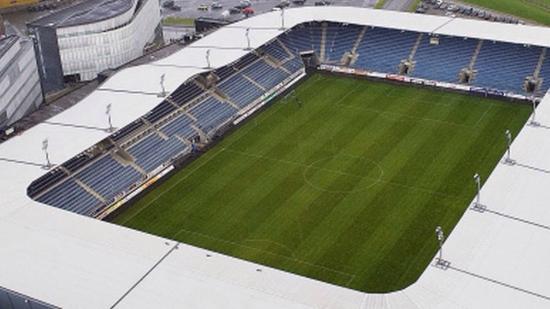
The Stavanger Stadion Legacy
The story of Lyse Arena (formerly Viking Stadion, later SR-Bank Arena) begins long before the first ground was broken at Jåttåvågen. Viking, founded in 1899, is one of Norway's oldest football clubs, and from 1917 to 2004 the team played at the old Stavanger Stadion. It was there that the club built its reputation as one of Norwegian football's most decorated sides: four consecutive league titles from 1972 to 1975, on top of championships in 1957–58, 1979, 1982 and 1991, plus cup wins in 1953, 1959, 1979 and 1989. The old ground's attendance record of 18,892, set at the cup semi-final against Odd in October 1959, still stands as a monument to that era — a venue that also staged internationals, including Norway's 2–1 win over England in 1971.
The old ground also received a fitting farewell. On 3 October 2002, Viking beat Chelsea 4–2 at Stavanger Stadion to win their UEFA Cup tie 5–4 on aggregate, having lost the first leg 2–1 at Stamford Bridge. Erik Nevland's goal three minutes from time knocked the London giants out of Europe and wrote itself straight into club folklore.
Opening Day at Jåttåvågen — 1 May 2004
Two years later, it was time to move. The new stadium at Jåttåvågen cost around 160 million kroner — with the City of Stavanger contributing 50 million plus the land — and was designed by LINK signatur together with NBBJ. With a railway station right outside the gates and the fjord for a neighbour, Viking gained one of Norway's most modern football grounds, built with the stands tight to the pitch.
The opening match was played on 1 May 2004 against Molde and finished 1–1, with Mads Timm going down in history as the first goalscorer on the new pitch, watched from the stands by then national team coach Åge Hareide. Capacity stood at 15,300 at the opening, grew to 16,600 in 2006 — the same figure as the ground's attendance record, set against Brann on 24 June 2007 — and was trimmed to 16,300 in 2012 when two giant screens were installed. Since 2018 the arena has held 15,900 spectators, split between 15,400 seats and 500 standing places.
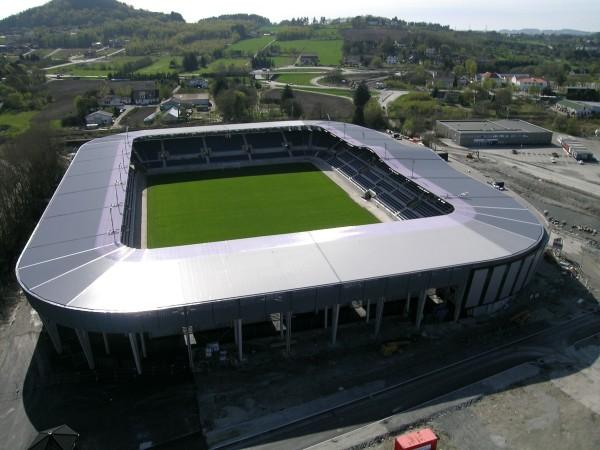
European Nights, Setback and Revival
The new home soon collected European nights of its own. In the autumn of 2005, Viking got past Portadown, Rhyl and Austria Wien to reach the UEFA Cup group stage, where they beat Monaco 1–0 at home in Jåttåvågen. Alongside the European evenings, the local derbies against Bryne and Haugesund have produced some of the ground's fiercest atmospheres, driven by the Felt O supporter stand.
Then came the hardest stretch of the club's modern history: relegation from the Eliteserien in 2017. Ahead of the 2018 season the natural grass was replaced with an artificial surface, and the turnaround was immediate — promotion was secured in November 2018 as 1. divisjon champions, and in December 2019 Viking lifted the Norwegian Cup after a 1–0 win over Haugesund in the final at Ullevaal, the club's sixth cup triumph.
Three Names, One Home
The stadium has carried three names without ever changing its soul. From the 2004 opening it was Viking Stadion, until a sponsorship deal with SpareBank 1 SR-Bank renamed it SR-Bank Arena in April 2018. On 14 January 2025 the ground took its current name, Lyse Arena, through a five-year agreement with the energy company Lyse. For the supporters in Jåttåvågen, the address has never changed — this is simply the home ground where the dark blues fill the stands every other weekend.
The Title Comes Home to Jåttåvågen
The greatest chapter in the arena's history was written on 30 November 2025. In front of a sold-out crowd of 15,900, Viking swept Vålerenga aside 5–1 in the final round of the season to clinch the club's ninth league championship — the first in 34 years, and the first ever sealed on the pitch at Jåttåvågen. Eight earlier titles belonged to the old Stavanger Stadion era; now the new home finally had one of its own.
Today, Lyse Arena is far more than a football ground. The stadium kick-started the transformation of Jåttåvågen from an industrial harbour area into a thriving new district, and the arena hosts concerts and cultural events, serving as a natural gathering point for the entire Stavanger region — a place where the legacy of 1917 and the future of Viking FK meet, match by match.